1928 was a year of big
changes for the Victor Talking Machine Co, as well as for
the phonograph business in general:
On January 6, 1927,
Eldridge Johnson, the founder of Victor, turned the
controlling interest of the company over to a banking
syndicate. The new owners were pressing for changes and new
products to reap more returns on their investment.
Also, the market had changed: Everyone now was looking for
electrically amplified radios and phonos, and the big
acoustic Victrolas of the past were no longer in fashion.
Small inconspicuous
tube-amplified Electrolas, or at least an acoustic machine
that looked like an Electrola were the order of the day. So
the majestic Credenza was replaced by the much smaller 8-35.
The first Victor changer
in the 10-50 now had a problem, because the changer required
a very large cabinet. It was just not possible to fit this
changer in a smaller cabinet. (10-50: 49.25"x48"x25.5")
In the fall of 1928,
Victor introduced a new Victrola with a new changer.
The 10-35 promised some exiting new features:
- Automatic intermix of 10" and 12" records
- Repeat of any record during play.
- easier reloading and unloading during play.
Thanks to the small
changer dimensions and a very compact horn,
this all could be done in a rather small cabinet:
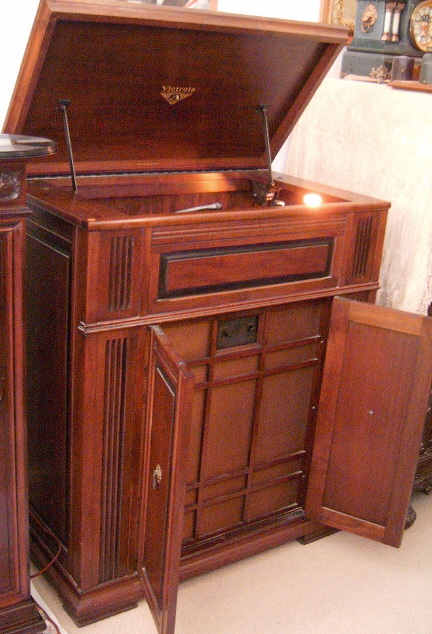
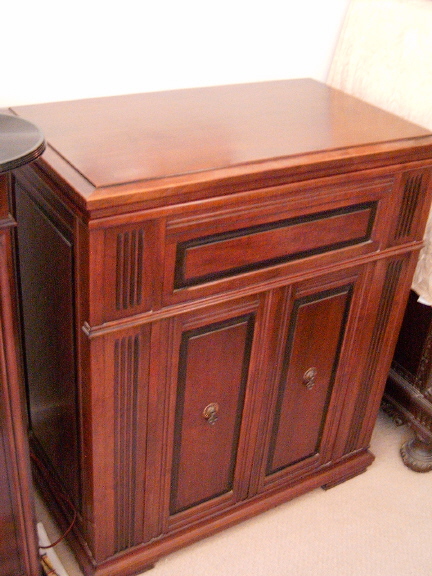
10-35: 40.5"x34.75"x20"
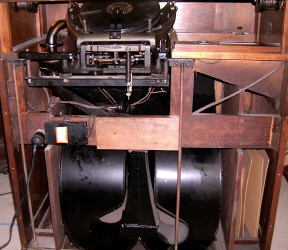
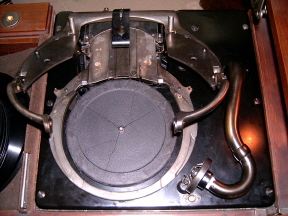
The new metal horn,
which is of Credenza length, is much more compact due to the
ingenious folding of the sound passage, and the changer,
only about 8" deep, saved more space by being hidden behind
the horn.
A new, quieter induction motor with a starting capacitor
provided silent operation with a high initial torque.
The intermix feature and
the repeat feature were new developments. The changer worked
by depositing a record from a hopper, aligned it correctly
for 10" and 12"sizes, and afterwards throwing it off the
turntable through a little leather tipped finger, which
rises under the record at the 10 o'clock position, whereby
the rubber-coated turntable grips the record and flings it
to the side. The repeat knob on the control panel could be
set for single repeat, meaning the same record would be
repeated once, and then the changer continued, or infinite
repeats.
It is also interesting
to note, that this changer shares these original features
with the HMV 1A changer simultaneously developed in Great
Britain. While the HMV approach is very different, the idea
of the finger and side throw-off are the same. Also, the
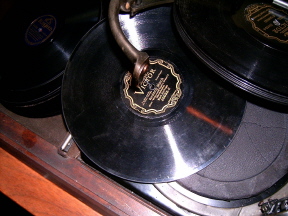
10-35 tone arm with an off-set soundbox suggests that the
tone arm and some other parts may have been obtained from or
designed by HMV.
So it seemed obvious that Victor had another success at
hands, and the bankers pushed for an early launch. However,
Eldridge Johnson's son, Fenimore Johnson, now the president
of Victor, refused to release this model citing insufficient
development and lack of reliability. The bankers overruled,
and so the disaster started:
The changer did not work correctly, broke and damaged
records, and Victor was forced to recall the machines for
expensive rework and redesign.
First Version of the
Changer
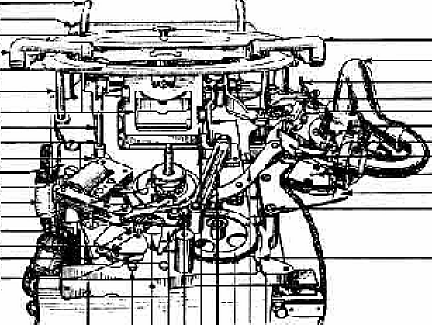
- two solenoids:
- trip mechanism is electric,
allows non-changer Victrola position
- second solenoid used in end-cycle
switch-off
- Repeat knob on control panel
- Record hold-down through a weight.
- No separator knives
- Switch off is done by needle touching a rubber pad on
motor board
- mechanical speed-up of motor during change cycle
A few of the original, un-reworked changers have survived,
and can be easily identified by the repeat knob on the
control panel.
Second Version of the
Changer (After Recall)
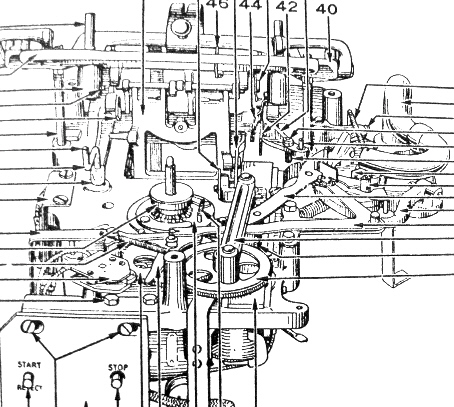
- two solenoids
eliminated:
- trip mechanism done by mechanical
linkage, NO Victrola position
- end-cycle switch-off is done by
mechanical linkage
- Repeat function eliminated
- No repeat knob or Victrola Position on control panel
- Record hold down by flat spring
- Separator knives added
- No motor speed-up during changer action
- Roller at the top edge of the reject compartment added to
improve record throw off.
The revised version of the changer, although with severely
reduced features and an agonizingly slow change cycle, was
indeed a workable and reliable changer, as long as
everything was in adjustment, and the turntable rubber had a
good grip.
Victor complemented the offering of its last acoustic 10-35
changer with a number of electrically amplified Electrolas,
all at an amazing price drop vs the
1927 first
Victor changer
models:
- Victor Automatic Orthophonic Victrola 10-35
(replaces 10-50) - $365 - acoustic phonograph
- Victor Automatic Electrola 10-69 (replaces 10-70) - $850 -
phonograph only
- Victor Automatic Electrola 9-54 (replaces 9-55) - $1350 -
radio and phonograph
- Victor Automatic Electrola 9-56 (replaces 9-55) - $1750 -
radio and phonograph in Chinese Lacquer chest
This was Victor's most expensive standard
production phonograph ever produced.
The problems of the
changer combined with the stock market crash of 1929 meant
that this changer did not sell in high numbers. In 1930, RCA
outfitted some surplus cabinets of the 10-69 and 9-56 (as
RE-156 for $595) with a single play turntable and a new
radio. After the retirement of these models in 1929,
RCA-Victor went "changerless" until the swinging magazine
changer RE-73 in 1931.
After the success of the first changer 10-50 outfitted by
after-market providers as a juke box, Victor thought they
had a new product for the sequential (non-selective) jukebox
market with this new changer.
Victor designed two
attractively priced commercial jukeboxes:
- 11-25 acoustically amplified juke box with second changer
- $550
- 11-25 electrically amplified juke box with second changer
- $950
However due to the reliability problems of the changer, only
five acoustic 11-25s were ever sold, no 11-50s.
Victor quickly abandoned the idea of becoming a major
jukebox provider.
However, standard 10-35s and other models with the improved
second changer continued to be updated by after-market
providers as attractive jukeboxes, I recently saw a nice
10-69 with glass sides that had been used as a commercial
jukebox.
A Word about Repairing
the second Victor Changer
Unlike the first changer, there are no problems with pot
metal parts, and the changer does not need any replacements.
This changer is not for the faint-of-heart, it is a
serviceman's nightmare.
Some pointers:
- The service manual for the revised changer is available in
Robert Baumbach's book "Look for the Dog" or in Rider's.
However, you will need also Service Bulletin No. 24 for the
first version, because it contains all the disassembly
information.
- The motor board is held by 4 screws at the corners. The
two middle screws are just decoration. You will also need to
unscrew the tonearm connector to the horn.
- Correct 10" record selection and shut off of the changer
depends on the changer being absolutely level.
- It is vitally important that - when the record lift
ring is in up position - the two hopper horns are spaced
somewhat more than a record's thickness above the ring. Make
sure that even with the pie-shaped distance washers put out
of the way, the horns still maintain a clearance. Otherwise,
damage to records and the changer will result.
- The turntable has to be very grippy. Make sure that the
record is always securely thrown off, and never remains
partly on the turntable or the ring. To make a turntable
grip better, a strong brushing with soapy water and a hard
bristle brush is suggested. To increase the grip further,
strips of Friction Tape have been applied to the raised
platter rim with good results.
- The throw-off finger has to be no more that 1/32" below
the record surface in rest position.
MACHINE INFORMATION
| Maker |
Victor Talking
Machine Co. |
| Model |
VE 10-35 |
| Year |
1928 |
| Owner |
Robert
Baumbach |
|
Repaired/Serviced by |
Carsten
Fischer |
I am always interested
to hear about other machines.
For restoration help and to get the service manuals, I am
happy to point you in the right direction.
Also, I am currently looking for a 10-35 like the one shown
above. If you see one for sale on craigslist, ebay or in an
antique store, please send me a short mail, I will be very
grateful.
You can reach me at:
sgimips1
"at" yahoo.com (replace "at" with @)
Also, do not forget to consult Robert Baumbach's book: "Look
for the Dog", which has excellent information on the history
of the Victrola and includes the service notes for the
revised 10-35 changer.
Many thanks to Robert Baumbach for allowing me access to his
machine, and Fred Rice for discussing the differences
between the version 1 and reworked version of the changer.
Again my great
thanks to Chuck Azzalina for his great help in creating
these pages.
Pleases check out his
other web pages
with even more fascinating early audio and TV tube
electronics. One level above this page, you can find more
fascinating changers with video clips.
MORE VIDEOS and LINKS
Robert Baumbach's "Look
for the Dog" with model and service information:
http://mulhollandpress.com
Also check out Robert Baumbach's great site of Old Record
Changers with a video of the Victor II changer:
www.oldrecordchangers.com
Bonus: A Serviceman's
Complaint
Greg Bogantz posted this
tale of his woes with a 10-35 changer a while ago:
Victor Changer Type II
This is not a posting about crap-o-phones.
With due credit to Monty
Python, "AND NOW FOR SOMETHING COMPLETELY DIFFERENT!"
Hereby hangs a tale: Well guys, I just spend the better part
of a week
being up to my elbows (literally) in bolts, locknuts, shim
washers, gears,
clutches, rubber bits, springs, adjusters, slides, cast
iron, cams, and
boiler plate. Yes, Virginia, I just finished reworking a
Victor Type II
record changer. Although this changer was also used in the
Victor 10-69 and
9-54 Electrolas, this one is in a 10-35 Orthophonic acoustic
Victrola.
Since this is an acoustic machine, it is within you
PhonoListers' bailiwick.
You, too, may someday have the pleasure of engulfing
yourselves in one of
these beasts. If you think the Edisons and Victors that
you've worked on so
far are interesting and challenging, you haven't seen
anything until you've
dug into one of these honkers. Those of you who have done
this already will
probably be smiling to yourselves as you read of my
exploits.
These are BIG machines. And they are HEAVY. I had meant to
weigh the
changer when I had it out of the cabinet, but I forgot about
that until I
had it 90% bolted back in again (no easy task, and not worth
undoing just to
weigh it). Rats. But I'm not kidding - this piece is made up
of several
large chunks of cast iron, "trimmed" (I use the word
advisedly) with a deck
plate made out of 10 or 12-gauge steel. They haven't made
AUTOMOBILES like
this since the 1920s, never mind record players.
Locomotives, maybe. With
the cast iron platter and the deck plate in place, this
thing must weigh
around 50 or 60 pounds. So prepare to do some grunting as
you rassle this
hog out of, and back into the cabinet. I would recommend
having a buddy
around to help. Then when you get it out of the cabinet,
you'll want to set
it down right away (wheeze). But you'd better prepare for
that in advance -
it's not designed to just sit on the bench. You need to make
a cradle of
some sort to hold the thing so that you can work on it.
Better lay in a
stock of angle iron and two-by-fours. I made a three legged
cradle that
supports it by propping up the bottom casting high enough
for all the
dangling bits to clear the benchtop. Just moving this pig
around on the
bench requires you to suck in your gut in preparation. And
you have to move
it around a lot to get at all the adjusters and fasteners on
it.
Since I also have a Victor 10-50 with the Type I changer, I
must
respectfully take issue with what Bob Baumbach says in his
"Look for the
Dog" book about the Type II being a "somewhat simpler"
design. Not by my
reckoning. The Type I changer is really pretty simple
(although equally
massive), and in fact the record singulation and ejection
design is actually
fairly elegant in its simplicity. The Type II internal
mechanism began as
basically the same as the Type I, but then they added about
that much MORE
stuff to it. The reason for this is that, unlike the Type I,
the Type II is
a full intermix changer. That is, it can handle 10 and 12
inch records
intermixed in the hopper in ANY order. These early Victors
are landmark
designs - the Type I is significant as it was the first
record changer sold
to the public, and the Type II is the first full intermix
design ever made.
Throughout the history of record changers, full intermix
models were fairly
uncommon (most later models were only partial intermix or
not intermix at
all). This makes the Type II all the more distinguished as
it was the first
of this type, AND it was used on an acoustic phonograph. So
far as I know,
the Victor Type I and Type II changers were the only ones
ever used on
acoustic phonographs sold for public consumption. That
discounts the
Hexaphone and other coin-ops made for commercial use, but
there weren't very
many of those, either, prior to these Victors.
What I find so fascinating about these early changer designs
is that
nobody (namely, V-M) "wrote the book" yet on how to make a
record changer.
Victor was there first, blazing the trail, doing some pretty
clever things
and also making some really stupid mistakes. Many
interesting designs
followed over the years until the Voice of Music Company
(V-M) design for
their model 900 in the 1950s just blew everyone else out of
the water. The
V-M design was so cheap and bullit-proof that nobody else
could compete with
it. So RCA, Zenith, Columbia and everybody else just threw
in their towels,
and that's why you see variations of the V-M design in every
American made
record changer made from the late '50s to the end of the
American consumer
electronics industry, sometime in the '70s. At which point
the Brits,
Germans, and Japanese took over the market.
But back to the early Victors: Even as I've said the Type I
is elegant
in its simplicity, I must describe the Type II as the result
of half a dozen
engineer's brain-leaks cast (literally - in iron) into an
engineering
nightmare. This thing looks exactly like a laboratory
prototype that the
beancounters ordered to be hurried into production. No
self-respecting
mechanical engineer would sign off such a monstrosity as
production-ready.
It has more adjustments than Carter's got little liver
pills. Even the
adjustments have adjusters. And lock nuts. Not to mention
the redundant
parts. And the band-aids. Just as you would expect to see on
the
first-pass protytype of a new piece of automation. Normally,
the second
engineering review of such a design would remove the
unnecessary parts and
adjusters and simplify the design so that it could be built
more efficiently
on an assembly line. Not this thing. Victor is known to have
had trouble
with this model. The first ones had even some additional
complexity over
the later ones in that they were electric solenoid operated.
I don't know
why they did this - I suspect they had visions of doing a
remote control for
this changer at a later date. But the solenoids were so
troublesome
(mostly, they were noisy) that Victor issued a factory
recall of these first
units. The solenoids were removed, and the entire machine
was reverted to a
fully mechanical design, which is the type that I have.
But that still didn't make it simple, by any means. Take a
look at the
pictures of this model and review the service procedures
described in the
appendix of Bob's "dog book". If it looks like the guy
stuffing his hands
into the guts of this thing is standing on his head to do
some of the
tweaks - he is. I guess it's theoretically possible to get
at these
adjustments with the changer in the cabinet, but you'd have
to be
ambidextrous, double-jointed, and very very strong. So you
really have to
remove the changer from the cabinet to twiddle with some of
these things.
You need to remove it to clean and lube it properly, anyway,
so you might as
well adjust it then, too.
Once out of the cabinet and onto your service cradle, you
are greeted
with the necessity of removing the deck plate to get at
anything else. If
you don't scope this out first (or read the service notes),
you'll find out
the hard way that the record hopper must first be removed.
This, of course,
necessitates the discomboobilation of two hopper height
adjustments. With
lock nuts. That you'll have to put back right again when you
reassemble it.
OK, done. Now, how the deuce do those axle pins in the back
come out?
Stare. Squint. Ah hah! There's a hidden E-ring clipped into
a slot on
each of the two pins and nestled BETWEEN the cast iron
hopper and record
loader ring. Guess what? You can't get any ordinary tool on
the blinkin'
thing to snap it off the pin. Oh, you COULD use the special
Victor tool
made for this purpose, part #51719 (really!). I'm sure we
all have one of
those handy. You wind up making a thin-bladed Y-shaped
hookus that does the
job. Guess which part is going to get redesigned before I
put THAT thing
back together again? OK, pins are out and that also releases
the record
loader ring which has to come off, too. Now what? Still no
soap. Now you
have to remove the trim ring around the tonearm, because you
have to finagle
the deck plate over the curvy tonearm to get it off the
machine. Oh? This
is clever. The trim ring is mounted with machine screws. AND
NUTS on the
bottom of the deck plate. Nimble, double-jointed, really
thin fingers, or
the services of a three inch midget standing inside the
machinery and
holding the nuts is the order of the day here. I don't
suppose it ever
occured to Victor to tap the 10-gauge sheet metal deck
(about the same
thickness as the nuts) instead of using separate nuts that
are impossible to
place. Note to engineering dept: On the next review . . .
Now that the deck plate is off and you can get to the
adjustments you
have to - guess what - put the record loader ring, the
hopper, the hinge
pins, and the goofed-up adjusters BACK ON the machine in
order to operate it
to set the other adjustments. By now, you're getting pretty
impressed with
the friendliness and serviceability of this creation. Sooner
or later,
you'll spy the wildly convoluted linkage contraption that
causes the machine
to shut off after the last record has been played. This mess
is the result
of changing over from the original solenoid operated design.
This linkage
is made up of a dozen individual bits and pieces with
pivots, slides, cams,
and springs all interconnected just to get one little motion
of the record
loader ring to unlatch a mechanical catch on the power
switch. Oh, and
while they were at it, Victor also implemented a mechanical
one-shot
trigger. With an adjustment. And a locknut. This whole
kaboodle could
have been replaced with two or three parts. Have I mentioned
redundant
parts yet? There's even more fun to be had when you're
setting this beast
up, but you get the idea. Don't forget that when you think
you're finally
done with it and you go to put the deck plate back on,
you've first got to
remove the record hopper and unloader ring. Finagle the deck
plate over the
tonearm and into position. Then remount the tonearm trim
ring. With those
little screws. And those #$%@ nuts that go under the deck
plate. Onto the
screws that you can't reach without the help of the 3-inch
midget. Then you
get to put the loader ring and hopper back on and reset the
hopper height
adjustments. Both of them. Again. With locknuts.
Getting the changer out of, and back into, the 10-35 cabinet
is a tale
unto itself. It sits on a weldment of angle iron that's
screwed into the
cabinet and serves as a pair of slide rails. To get it out,
you first have
to remove the bolts fastening it to these rails, then remove
the spacers
that hold it propped up just a little above the rails. Why
didn't Victor
just raise the rails in the first place? Did I mention
redundant parts yet?
And I STILL don't know how those Victor guys ever got those
little &^$#%&
spacers under the front two mounting bolts of the deck
plate. They had to
have a five inch tall midget who could stand on top of the
metal horn and
lift the front of the 60-pound changer with one hand while
he slipped those
$#%^& spacers into position with the other hand. Which
positions, of
course, are completely out of reach of ordinary mortals. So
I left the
front spacers out of mine when I put it back together. They
don't serve any
purpose, anyway. Did I mention redundant parts yet?
Then, on the 10-35 acoustic model you have to connect the
plumbing to
the tonearm. Looks easy. Not. First you have to raise the
changer up so
that you can slather a liberal dose of grease on the
machined mating cast
iron flanges. It will move upward only about an eighth of an
inch before it
bangs into an obstruction, so you get to do this greasing
with a thin putty
knife or some such utensil. Victor advises in the service
manual that you
also apply shellac to the felt washer gasket. Shellac? AND
grease? Did I
mention redundant parts yet? I don't think the guy who wrote
the service
notes ever actually worked on one of these pigs. OK, now
you've got an
airtight seal at the flanges. (Never mind the air leakage
around the
double-race ball bearing in the tonearm that Victor
conveniently FAILS to
mention in the service notes. Not a word about it.) All you
have to do now
is put in the three screws to clamp the flanges together. Uh
. . . Umm . .
.%&#$% !!! How in tarnation did those guys ever get these
blunt-end screws
to line up with the blind holes in the top flange? Grunt.
Try to shift the
60-pound changer sideways just a freckle. Nope. Still no
match. So,
engineering fix #37A is implemented: Grind a chamfer on the
screw ends so
that they can "find" the blind hole easier and cam into it.
OK, so I've complained a little about how difficult it is to
work on
this thing. But, being the mechanical wonder that it is, it
constantly
amazes you when you finally get it done and you watch it
work correctly.
Truly an awesome chunk of machinery. The dispensing of a 10
inch record
from the hopper goes on without much to alert you to the
various gyrations
going on in the machine. But, of course, you'll know what's
really
happening from having adjusted all those hidden movements.
With locknuts.
But when it comes to putting out a 12 inch record, you find
yourself holding
your breath as you watch it pushed WAY OUT of the hopper,
then wait to see
if it slides sloooowwly back down the loader ring as it's
supposed to (under
gravity), and that it mates correctly on BOTH of the 12 inch
index pins
which will hold it in the correct orientation to allow the
hole to mate with
the platter spindle when the loader ring flops down. Ahhh,
it made it.
Another successful cycle completed. For all of the goings on
when this
machine cycles, it is eerily quiet during most of the cycle.
Nail-bitingly
so. Is the record dispensing squarely? Will it hit the index
pins
correctly? You come to anticipate the four significant
commotions that
occur during a cycle: 1) - A scraping noise as the mechanism
is first
tripped (this is the unavoidable result of metal parts
scraping together as
the ratchet drive clutch is triggered). 2) - The clatter of
the played
record as it is slung off the platter and into the spent
record compartment.
Did it go all the way? Did it crack this time? And now - a
long, nervously
quiet pause. The record dispensing motions are almost
noiseless. Then 3) -
A scrape and clunk as the record loader ring is sent home
and deposits the
next record on the platter. Then the needle sets down on the
record.
Followed shortly by 4) - That same scraping noise that
started the cycle as
the drive clutch disengages. If all is well, you don't hear
an additional
noise 2b) just after the played record is slung off. That
would be the
crunching of the record as it is caught between the loader
ring and the
hopper and busted into shards because it didn't get slung
properly out of
the way during noise 2. Ahh, the joys and mystery of it all.
What a great
machine! And a helluva conversation piece.
Greg Bogantz
|