The 1930s were the dark
age of the record changer: The general lack of money due to
the great depression, but also a shift away from records
towards the radio led cost saving and design simplification
for record changers that eventually led to the prevailing
drop changer design by the mid-1930s.
As an illustration on
how bad things were, Victor record sales from a high of 38
Million in 1927 had dropped to an all-time low of 3.1
million in 1931.
Few people had the money
or the interest to buy expensive record changer in the midst
of the great depression, therefore simplified designs were
required, and no one better than General Industries could
provide the absolute lowest in record changers.
And again steps on the scene Mr. Homer Capehart, arguably
the greatest talent scout for record changers. Not only did
he discover the famous
CAPEHART
changer, lying forgotten at US Columbia. After his quick
ouster from his own Capehart Company, he found the famous
Wurlitzer Simplex mechanism, and joined that company as
their head of sales. The story goes, while he was
approaching Wurlitzer, Capehart also held the rights to the
General Industries changer, but Wurlitzer wanted a selective
jukebox mechanism, not just a changer.
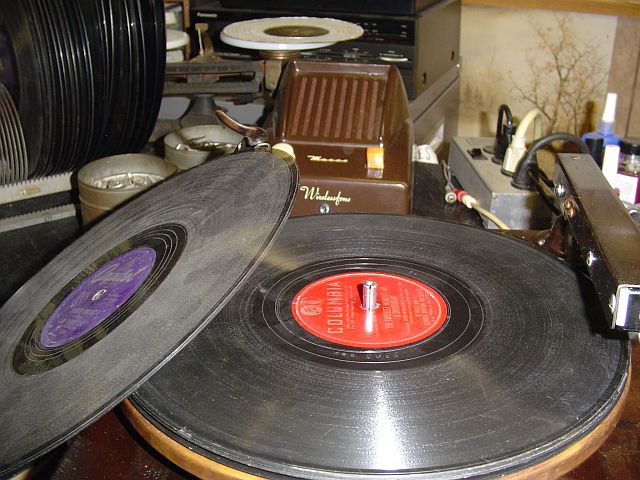
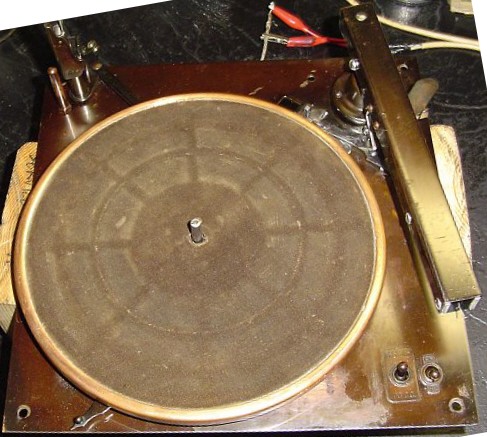
The General Industries K changer (10" only) or L17 changer
(10" or 12") is the most simplistic, cheapest and fastest
changer possible. It was very successful and produced from
1932 to at least 1939. Used by major brands, like Philco,
Sparton and Scott, as well as sold as a portable player by
the Liberty Music Shop of New York, this changer is found in
many consoles from the 1930s.
The design is very
similar to the contemporary RCA 15U changer, which also
played a stack from the top to the bottom, but used a more
gentle version of a transfer arm grabbing the spindle hole
of the topmost record.
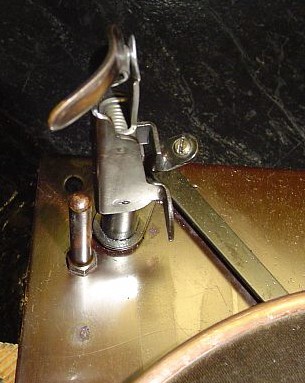
The changer works by having a stack of records sitting on
the turntable. When tripped, a knife edged "Slasher" goes
under the rim of the top record, and throws it off the
spindle. The mechanism is adjusted in a way that the slasher
misses the last record. Therefore, the last record on the
changer repeats indefinitely,
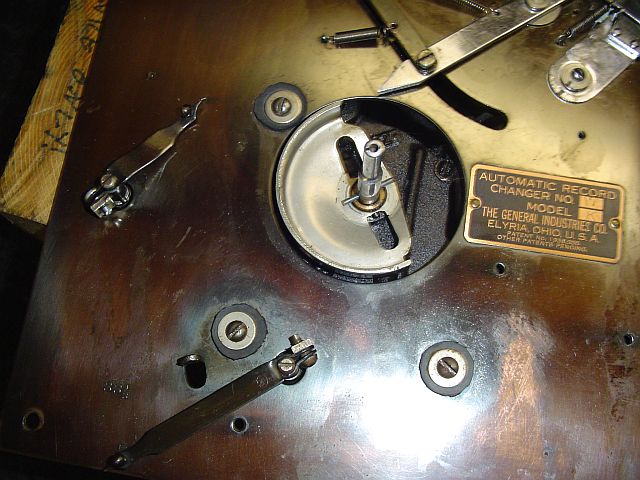
The linkages you see in
the picture is all there is to the whole changer: While all
other changers had a geared cam that would run slower than
the turntable, here the half circle disc on the spindle is
the cam. That means that the whole cycle takes one-half
rotation of the spindle, or something less than .5 seconds!
During the cycle, the tone arm is thrown out by the single
lever, but a dashpot ensure that the tonearm comes down with
a time delay and gently.
It is notable that this is one of the first changers that
abandons the "constant VTA" principle, which means that only
one record is on the platter at any time. Even though we may
think that constant VTA (a term used for stereo LPs) was on
the mind of the designers, the challenge was not so much the
varying tone arm angle, but that with the heavy pick-ups the
top disc may slip and not play correctly. This problem
continued through all later drop changers, until the
light-weight tonearm became established. It is not rare to
find records of the period with a "no slip" velvet ring
pasted on the label.
The GI changer (as did the RCA 15U) avoided slippage by
having a small tension spring along the spindle, which held
the records securely.
Even though the GI "Slasher" changer is very disturbing to
watch, it actually works quite reliably, was cheap and
available. The record rims may have suffered from the knife
edge, but then all other drop changers of the 1930s employed
separator knives which would chip records.
MACHINE INFORMATION
| Maker |
General
Industries |
| Model |
K |
| Year |
1932 - 1939 |
| Owner |
Gib Epling |
|
Repaired/Serviced by |
Gib Epling |
I am always
interested to hear about other machines.
You can reach me at:
sgimips1 "at"
yahoo.com (replace "at" with @)
Many thanks to Gib Epling for providing photos and the video
of his machine, and Fred Rice for providing detail
information.
Please check out Gib's
West-Tech Services
http://www.west-techservices.com.
Gib provides expert repair and
rebuilding services for all record players and changers.
Also many thanks
to Robert Baumbach for editing and preparing the video.
Again my great thanks to
Chuck Azzalina for his great help in creating these pages.
Pleases check out his
other web pages
with even more fascinating early audio and TV tube
electronics. One level above this page, you can find more
fascinating changers with video clips.
MORE VIDEOS and
LINKS
Also check out Robert Baumbach's great site of Old Record
Changers:
www.oldrecordchangers.com
|